Why it asks who your customers are
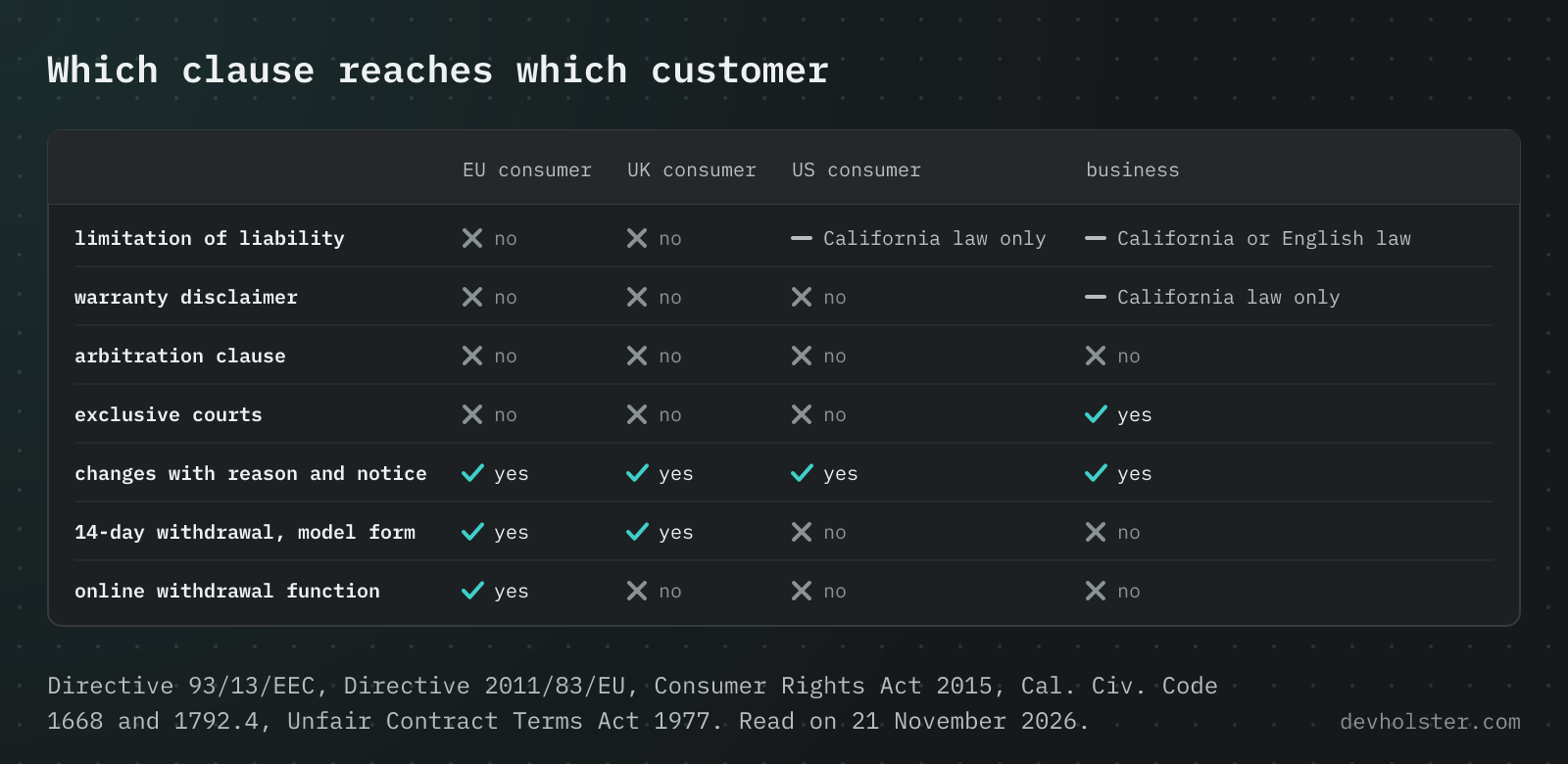
Most generators ask what your product has, such as accounts, payments and user content, and then print the same clauses for everyone. This one asks two more things first. Are your customers consumers or businesses, and where are they? Those two answers decide more of the text than all the others together.
The reason is that a consumer keeps the protection of the country they live in, whatever the terms say. Article 6(2) of the Rome I Regulation says a choice of law cannot deprive a consumer of the rules that cannot be set aside by agreement, and the UK kept the same article. So a clause that is fine in a contract with a company can be dead text in a contract with a private person in Lyon or Leeds.
Between businesses it works the other way round. There the governing law you choose decides whether a limitation of liability holds, and that is why the tool asks for it. It was read for California and for England and Wales. Under any other law the text names your choice and writes no limitation, and a note under the text says so.
You never see a question the answers cannot use. If your customers are consumers in the EU only, the liability group is not shown at all.
The rest follows the pattern of our privacy policy generator. Every option starts unselected, the text appears when the last mandatory answer is in, and the sources tab names the provision behind each paragraph. What separates the two documents is the subject of our guide to privacy policy vs terms of service.
Terms of service, terms and conditions, terms of use
They are one document under three names. The Digital Services Act settles it in a definition. Terms and conditions are "all clauses, irrespective of their name or form" that govern the relationship between a provider and its users. Pick the name your audience expects in the first question, and the title of the text follows.
What a limitation of liability can do
This is the clause people want a generator for, and the one that goes wrong most often when it is copied.
In the EU, the Unfair Terms Directive puts two things on its list of terms that may be unfair: excluding liability for death or personal injury, and inappropriately limiting the rights of the consumer when the trader does not perform. An unfair term does not bind the consumer. How far a limit may go below that line is decided by each member state, and the answers differ.
The UK wrote its version into statute. Under section 65 of the Consumer Rights Act 2015 a trader cannot limit liability for death or personal injury resulting from negligence. Under section 57 a term cannot exclude liability for a service performed without reasonable care and skill, and cannot limit it below the price paid. Whatever is left has to pass the fairness test, and the terms that often fail it are listed in Schedule 2 of the Consumer Rights Act 2015.
So for consumers in the EU and the UK the generator writes no limitation at all. Where a limitation exists for other customers, it opens by saying whom it reaches.
IN NO EVENT SHALL WE BE LIABLE
FOR ANY DAMAGES WHATSOEVER.
This section applies only if you use
Harbor Notes for a business or you are
a consumer in the United States. It does
not apply to consumers who live in the
European Union or the United Kingdom.

Nothing in these terms excludes or limits
liability for any of the following.
- Fraud.
- Intentional misconduct or gross negligence.
- Wilful injury to a person or to property.
- A violation of law.
The list on the right comes from California. Civil Code 1668 declares contracts that exempt anyone from responsibility for their own fraud, wilful injury or violation of law to be against the policy of the law. For business customers under English law the list changes to death or personal injury caused by negligence, which section 2(1) of the Unfair Contract Terms Act 1977 takes out of reach, and to fraud. Under both laws the tool also keeps intentional misconduct and gross negligence out of the limit. No English statute asks for that. We leave it in because the EU Data Act treats such a limit as unfair between businesses where data is concerned.
After the carve-out comes the limit itself, either the fees of the last 12 months or a fixed amount you enter. The tool does not offer the first one for a free product, because a cap of zero fees is no cap.
Two things stay open however the clause is written, and the notes under the text name them. An English court tests a limit in standard terms for reasonableness, unless English law applies only because the contract chose it (section 27 of the same Act). A California court can refuse a clause it finds unconscionable.
Why the warranty disclaimer is in capitals, and missing for consumers
The sentence in capitals that every American contract seems to contain has a source. California Commercial Code 2316 lets a seller exclude the implied warranty of merchantability only in words that mention merchantability, and in writing only if they are conspicuous. "As is" does the same job for all implied warranties.
Capital letters are the traditional way to be conspicuous. The definition in Commercial Code 1201, amended with effect from January 2024, names no typeface at all and asks whether a reasonable person ought to have noticed the term. The generator keeps the capitals and puts the disclaimer under a heading of its own.
It writes the disclaimer for business customers under California law, and for nobody else. EU consumers have a legal guarantee that a digital service conforms to the contract, and Article 22 of Directive (EU) 2019/770 makes any term that derogates from it non-binding. UK consumers have sections 47 and 57 of the Consumer Rights Act.
For consumers in the United States the obstacle is California's Song-Beverly Act. Civil Code 1792.3 allows the implied warranties on consumer goods to be waived only through an "as is" sale, and 1792.4 makes that sale effective only if a conspicuous writing is attached to the goods. A paragraph in terms of service is not attached to anything. Whether a paid app counts as consumer goods is a question we do not answer for you, so the clause stays out.
14 days and a button
A consumer in the EU can withdraw from a contract concluded online within 14 days, and the trader has to explain how before the order. The Consumer Rights Directive comes with model instructions in its Annex I, and a trader who hands them over correctly filled in has met the duty. The generator therefore uses the model word for word. It reads stiffly and mentions delivery costs that a SaaS does not have. That is the price of the safe wording.
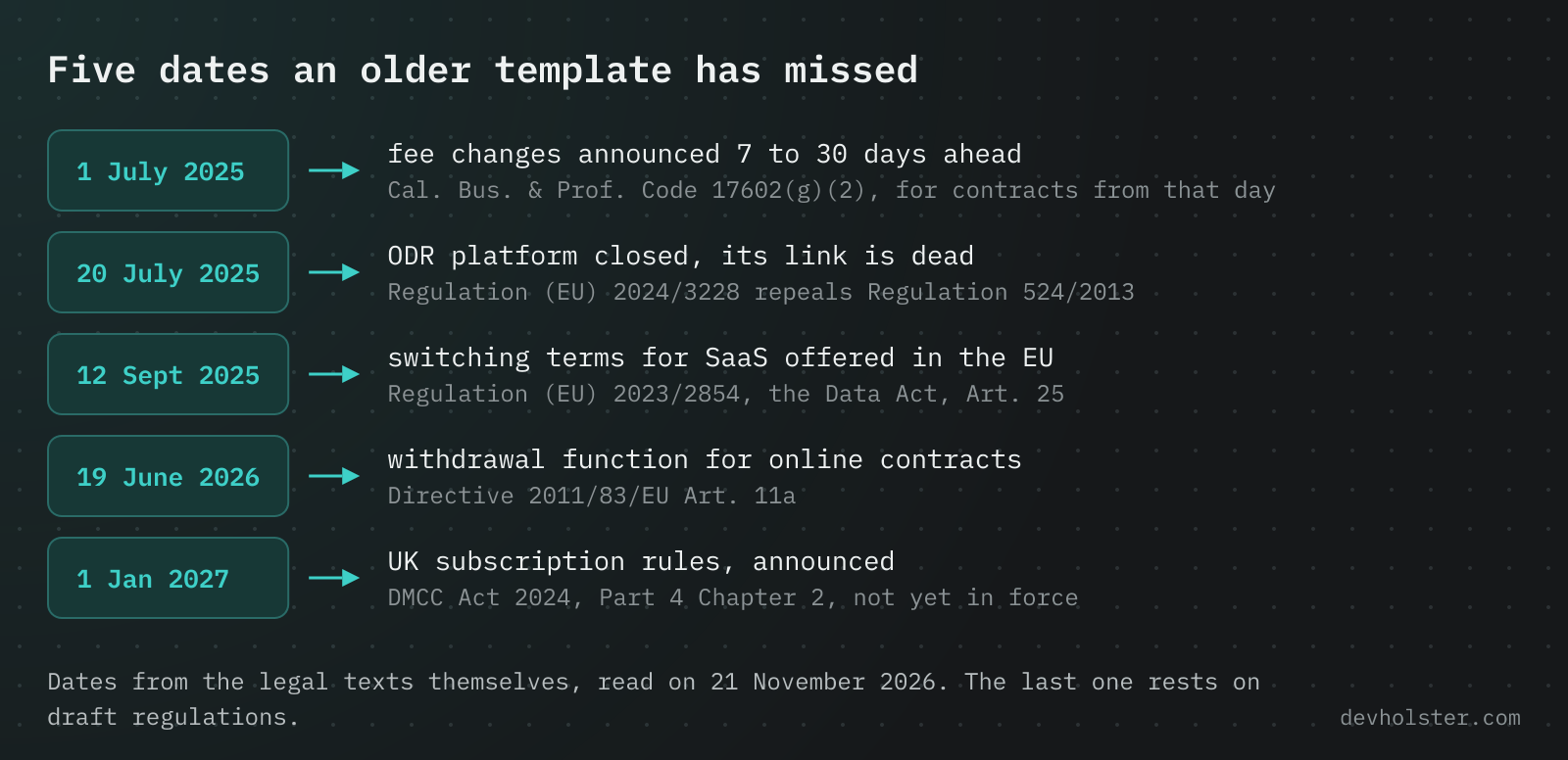
One part of it is new. Since 19 June 2026 a contract concluded through an online interface needs a withdrawal function, labelled "withdraw from contract here" or something as clear, available for the whole period. The model instructions gained a sentence that says where the function is, and the tool asks you for that address.
For a service the model carries one more sentence. Someone who asked for the service to start right away and then withdraws pays for the days used. The tool prints it for every service, as the Annex does, and the sentence only bites if your checkout collected that request. Without the sentence in the instructions the consumer pays nothing either way.
One answer changes the text. If you sell digital content that is delivered at once, the right ends at delivery, provided checkout collected express consent and the acknowledgement that the right is lost.
The UK has the same right under a different name, the right to cancel, with its own model text in Schedule 3 of the 2013 Regulations. It has no withdrawal function. The generator writes each version only for the consumers it belongs to.
Is a free service affected? In the EU it can be. A digital service that people pay for with personal data falls under the same directive, unless the data is used only to provide the service. The tool asks, and writes the withdrawal section if the answer is yes.
Subscriptions and price changes
The strictest rules on renewals that this tool has read are Californian. Whoever lets people subscribe online has to let them cancel online, through a link or button in the account or through a prepared email, and may not put steps in the way (Business and Professions Code 17602). A change of the fee has to be announced no less than 7 and no more than 30 days before it takes effect.
That window is why the text says 30 days and not "at least 30 days". The second wording is what EU practice suggests, and in California it would be too early.
At federal level the picture changed in 2025. The FTC's amended Negative Option Rule, known as click to cancel, was vacated by a court of appeals in July 2025, and the old rule was restored in February 2026. What remains for online subscriptions is the Restore Online Shoppers' Confidence Act: clear disclosure before billing details are taken, express informed consent, and a simple way to stop the charges.
In the UK, new rules on subscription contracts with reminder notices and a second cooling-off period are announced for 1 January 2027. They are not in force and not in the text. If you have UK subscribers, come back for a new version around that date.
Much of this happens at checkout and not in the terms. The tool lists those duties as notes under the text.
When users post content
A product that stores what users write or upload is a hosting service under the EU Digital Services Act, however small it is. Article 14 wants the terms to state every restriction on that content, the measures and tools used for moderation, whether decisions are made by people or by software, and how a user can complain. Those are four questions in the tool, and their answers become the content section.
Two cases get no text. An online platform above the size of a small enterprise has more to put into its terms, and so does any service on which people in the United Kingdom can see what other users post. The Online Safety Act 2023 makes such a service describe how it protects users from illegal content, and that description follows from a risk assessment only the operator can do.
Comments on your own articles are exempt from the UK regime. Content only its author can see is outside it, as long as the product has no function to share it. A share link nobody uses still counts.
For the United States the tool asks whether you have registered a DMCA agent with the Copyright Office. If yes, the text carries the agent's contact details, the six elements a notice needs and the sentence on repeat infringers. If no, it carries none of that and tells you what you are missing. It also never writes a clause that keeps customers from reviewing you. The Consumer Review Fairness Act makes such a clause void from the start.
SaaS and the Data Act
Since 12 September 2025 the contract of a data processing service offered in the EU has to set out how a customer can leave: a notice period of two months at most, a transitional period of 30 days, at least 30 days to retrieve the data, and erasure afterwards. Recital 81 of the Data Act names SaaS as one of the service models. From 12 January 2027 no charge may be made for switching.
The same contract has to list a web page of yours. Article 28 wants it to name the jurisdiction your infrastructure is subject to and what you do against access to customer data by authorities outside the EU. The tool asks for its address and does not write the page.
Four paragraphs old templates still carry
Open the terms you have and look for these.
- A link to the European ODR platform. The regulation behind it was repealed with effect from 20 July 2025 and the platform was shut down. The link now points at nothing.
- A "California notice" with the address of the Department of Consumer Affairs. It rests on Civil Code 1789.3, which applies to an electronic commercial service. The definition next to it covers systems for buying tangible items or physical services and expressly not computerized data. A SaaS or an app that ships nothing does not need the paragraph.
- "We may change these terms at any time." Towards consumers in the EU and the UK a right to change terms needs a valid reason named in the contract, or at least notice and a way out.
- Mandatory arbitration with a class action waiver, addressed to everyone. For a consumer in the EU or the UK that paragraph is at best decoration.
None of the four comes out of this generator, and the test suite fails if one ever does.
What it leaves out, and what it asks for
The first version covers websites, SaaS and apps. A shop that ships physical goods gets no text, because goods bring delivery, returns and a guarantee regime of their own. A service for children gets none either.
There is no arbitration clause for anyone. For business customers that is a gap we intend to close. For consumers in the United States it is a decision. Whether such a clause holds depends on how people agreed to it, and the tool cannot see your sign-up screen.
For the United States the tool read federal law and California law. If your governing law is that of Delaware or New York, you get a text without a limitation of liability. That costs us users who would have been happy with boilerplate, and we would still sooner ship the shorter text than a clause nobody checked.
The length follows the answers. A blog for readers in the EU with no accounts comes out at 352 words. The sample answers describe a SaaS with subscriptions and customers in the EU, the UK and the United States, and that text runs to 2,819 words, most of them the two statutory withdrawal models and the Data Act section.
The tool never calls its output binding or enforceable. Terms bind people who agreed to them, so the text belongs where people sign up or pay, with an acceptance step.
It costs nothing and asks for no email address. The price is one line at the end of the text, "Created with the Terms of Service Generator by DevHolster", with the name linked to this page. The tool has no switch for it. If you keep the Markdown version in a repository, the Markdown to HTML converter turns it back into a page.
Before a release, a script builds 10,800 documents from combinations of answers plus 20,000 random ones, and checks each for clauses that reach the wrong customer, for sections nobody asked for and for missing mandatory content. It cannot check whether your answers are true.
Terms and conditions, asked plainly
Are terms and conditions required by law?
No law makes a website publish a document with that name. What the law requires is specific information, and terms are where it usually goes. In the EU a trader who sells to consumers online has to give identity, contact details, the conditions for ending the contract and the right of withdrawal before the order (Article 6 of Directive 2011/83/EU). A service that stores what users post has to state its content rules and its moderation in the terms (Article 14 of the Digital Services Act). Apple and Google Play add conditions of their own for apps.
What is the difference between terms of service, terms and conditions and terms of use?
None in law. The Digital Services Act defines terms and conditions as all clauses that govern the relationship, irrespective of their name or form.
Are terms and conditions legally binding?
Only for people who agreed to them, and then clause by clause. Agreement means the text was shown at sign-up or checkout and accepted there. After that each clause still has to pass the law of the customer. In the EU an unfair term in a consumer contract is not binding on the consumer, while the rest of the contract stays in force (Article 6(1) of Directive 93/13/EEC). The UK has the same rule in section 67 of the Consumer Rights Act 2015. A generator can leave such terms out. It cannot make the rest binding.
What should terms and conditions include?
Who operates the service and how to reach them, what the service is, the rules for using it, what happens to content users post, prices with renewal and cancellation for anything paid, how the terms can change, how either side can end the contract, the governing law and the courts. For consumers in the EU and the UK add the 14-day right of withdrawal with its model form. Leave out sections for things the product does not have.
Is a limitation of liability clause enforceable against consumers?
Against consumers in the EU and the UK, mostly not. Directive 93/13/EEC lists terms that exclude liability for death or injury, or that inappropriately limit the rights of the consumer when the trader performs badly, among the terms that may be unfair. The UK Consumer Rights Act 2015 bars any limit on liability for death or personal injury from negligence (section 65) and any term that limits liability for a carelessly performed service below the price paid (section 57). In California a limit can hold, but Civil Code 1668 puts any exemption from responsibility for fraud, wilful injury or a violation of law against the policy of the law.
Can I use a terms and conditions template?
A template gives you every clause and leaves the deleting to you. That is where it goes wrong, because the clauses that have to go depend on who your customers are. A limitation of liability written for a US business customer does not bind a consumer in France, and a template cannot know which of the two you have. If you use one, check each clause against the law of the place your customers live in, and delete whole sections for features you do not offer.
Do I need both a privacy policy and terms of service?
Yes, they do different jobs. A privacy policy is information the law makes you give about personal data. Terms are the contract for using the service. Keep them as two documents, because one is read as information and the other is agreed to.
Where do I put terms and conditions on a website or app?
Link them where people sign up and where they pay, next to the button, and keep a permanent link in the footer. An app needs the link inside the app as well. Apple asks for links to the privacy policy and the terms of use within an app that sells auto-renewing subscriptions, and Google Play wants users to accept the terms before they can post content.
Do terms of service need an arbitration clause?
No. In the EU a term that sends consumers exclusively to arbitration is on the list of terms that may be unfair, and in the UK an arbitration clause is unfair by statute for claims up to 5,000 pounds (section 91 of the Arbitration Act 1996). In the United States the Federal Arbitration Act makes such clauses valid in principle, but whether one holds depends on how consent was obtained and on fairness in the single case.
What is the 14-day right of withdrawal for digital services?
Consumers in the EU and the UK can withdraw from a contract concluded online within 14 days, without giving a reason. For a service such as a SaaS subscription the period starts when the contract is concluded. If the consumer asked for the service to start at once, they pay for the days used. For digital content that is delivered at once, a download for example, the right ends at delivery if the consumer expressly agreed to that and acknowledged losing the right, and in the EU the trader confirmed both. Since 19 June 2026 a trader who concludes contracts with EU consumers online also needs an online withdrawal function.
Do I need a DMCA policy in my terms of service?
Only if users can post content and you want the safe harbor of 17 U.S.C. 512(c). It covers a provider that has designated an agent for infringement notices, registered that agent with the US Copyright Office and published the name, address, phone number and email address of the agent on its site. The provider also needs a policy of terminating repeat infringers and has to tell users about it.
Can I change my terms of service without telling users?
Not towards consumers in the EU or the UK. A term that lets a trader alter the contract without a valid reason named in it is on the list of terms that may be unfair in both. For a contract without a fixed end, the trader can reserve the right to change the terms if the consumer gets reasonable notice and is free to leave.
Is the ODR link still required in EU terms and conditions?
No. Regulation 524/2013 was repealed with effect from 20 July 2025, and the platform is gone.
Does an app need its own EULA?
Not necessarily. Without a custom license agreement, Apple's standard EULA applies to an iOS app. If you supply your own, it has to contain ten minimum terms that Apple sets out, among them that the agreement is between you and the user and not with Apple, and that Apple is a third party beneficiary of it. Google Play wants an app with user content to have terms that define objectionable content and prohibit it.
How is a SaaS agreement different for business customers?
Between businesses the governing law decides most of it, so a limitation of liability and a warranty disclaimer are possible where the same clauses would not bind a consumer. Under English law a limit in standard terms still has to be reasonable (Unfair Contract Terms Act 1977), unless English law applies only because the contract chose it, and in California a court can refuse to enforce a clause it finds unconscionable. In the EU the Data Act adds something for both kinds of customer. The contract of a data processing service has to say how the customer can switch to another provider and take the data along.