Why it asks so much
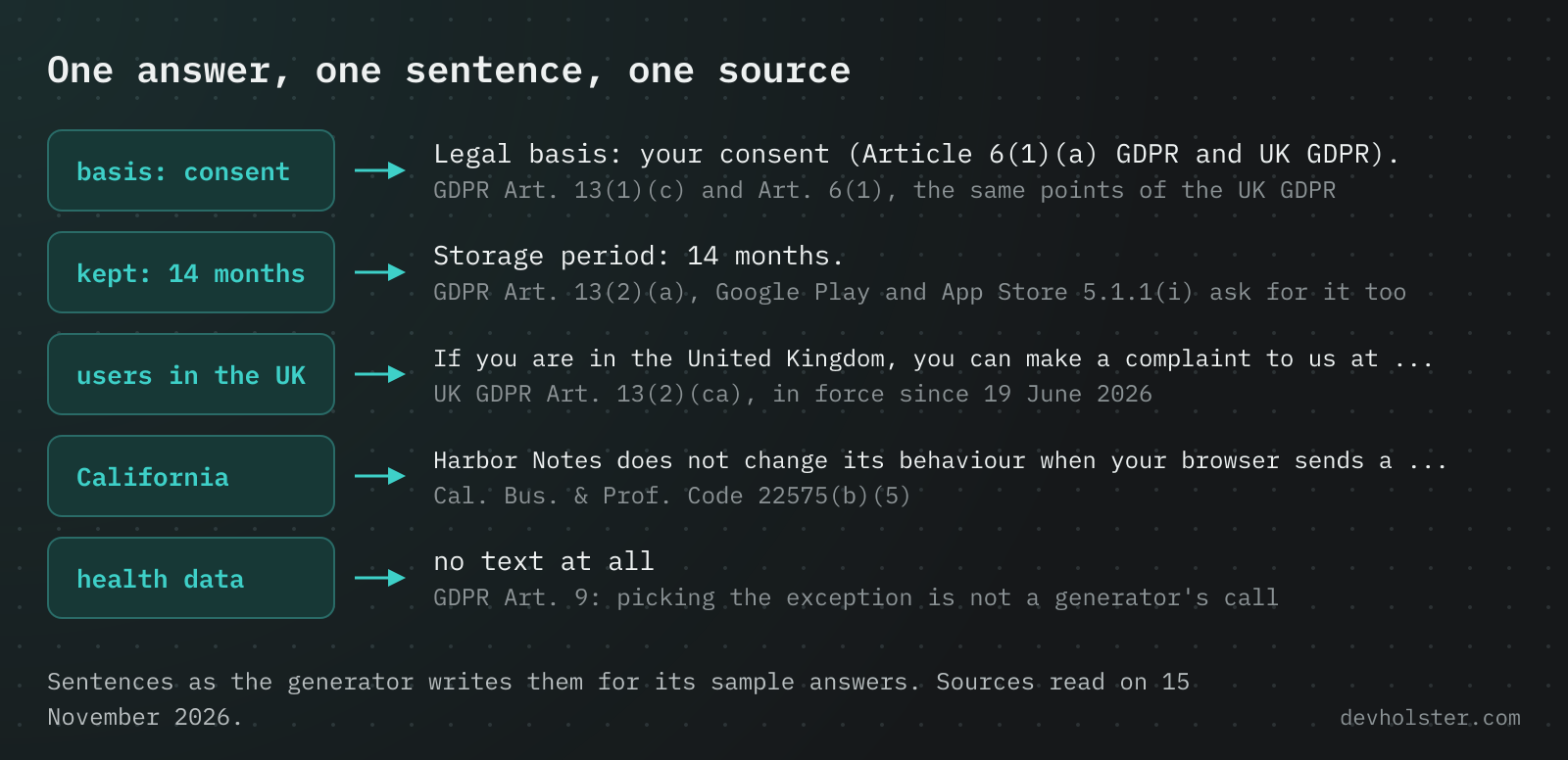
The questionnaire has nine groups, and a blog with a contact form and analytics ends up with between twenty and thirty answers. That is more than most generators ask for. The reason sits in Article 13 of the GDPR, which wants the legal basis and the storage period for every single purpose. Each purpose you tick therefore gets those two questions of its own, and a third one if the basis is a legitimate interest, because the interest has to be named.
No choice about your product is made for you. Every option starts unselected, because a preselected "we use cookies for analytics" is how policies end up describing a site that does not exist. Three text fields do start with a suggestion: the effective date, the storage period of each purpose and the legitimate interest behind it. Treat the storage periods as a starting point and replace them with what your systems really do, because whatever stands in the field goes into the text.
The right side stays empty until the last mandatory answer is in. Until then it lists what is missing, and every line jumps to its question. A policy with a gap looks exactly like a finished one, so the tool does not show half of one.
If a question does not apply to your product, it is not shown.
The list of what a product processes ends with "something else". Embedded videos, maps and fonts send a visitor's IP address to another company, and no checkbox can know which ones your pages load. Describe them there, with a legal basis and a storage period of their own. The answers are also checked against each other. Tick Stripe without payments or Google Analytics without usage analytics, and the tool asks which of the two is wrong before it writes anything.
Once the text is there, the sources tab goes through it paragraph by paragraph and names the provision each one answers to, linked to the text of the law or the store policy. A paragraph that no active module asks for is marked as coming from your answers. That view is the quickest way to check our work, and we would like you to.
What each rule wants in the text
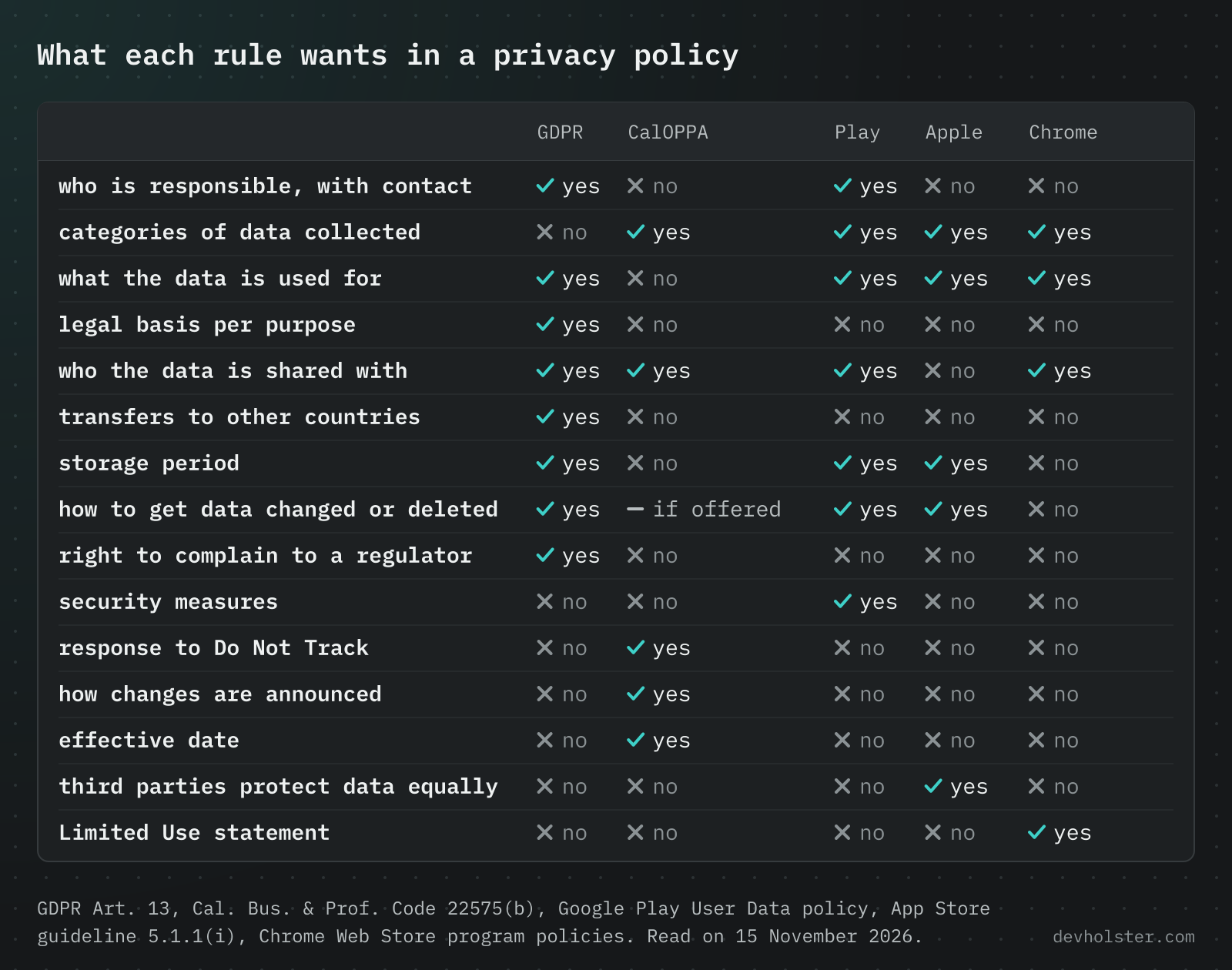
Article 13 applies when personal data is collected from the person it is about. It has twelve points, six in each of its first two paragraphs, and the UK version keeps nine of them word for word. The UK added a thirteenth, which sits in the table where the UK text puts it.
| Provision | What the policy has to say | Where it comes from here |
|---|---|---|
| Art. 13(1)(a) | Who the controller is and how to reach them, plus the representative if there is one | Operator, email, representative |
| Art. 13(1)(b) | How to reach the data protection officer, where one exists | Data protection officer |
| Art. 13(1)(c) | The purposes of the processing and the legal basis for each | What it processes, legal basis |
| Art. 13(1)(d) | The legitimate interest, where that is the basis | Which legitimate interest |
| Art. 13(1)(e) | The recipients or categories of recipients | Which companies receive data |
| Art. 13(1)(f) | Transfers to third countries and what they rest on | Location and transfer basis per company |
| Art. 13(2)(a) | The storage period, or the criteria that decide it | Kept for how long |
| Art. 13(2)(b) | The rights of access, rectification, erasure, restriction, objection and portability | Fixed text |
| Art. 13(2)(c) | The right to withdraw consent | Appears when a purpose rests on consent, and always with sensitive data |
| UK GDPR Art. 13(2)(ca) | The right to complain to the controller itself, UK only and in force since 19 June 2026 | Appears when users are in the UK |
| Art. 13(2)(d) | The right to complain to the supervisory authority | Fixed text, different in the EU and the UK |
| Art. 13(2)(e) | Whether providing the data is required by law or contract | Built from the legal bases you chose |
| Art. 13(2)(f) | Whether automated decision-making takes place, and if so its logic and its consequences | The special cases question, with three fields if it does |
Article 12 adds how all of this has to be written, namely "using clear and plain language". The clause library takes that literally. A storage period reads "Storage period: 30 days." and not a paragraph about retaining data for as long as necessary for the purposes set out herein.
California's CalOPPA is shorter and odder. Section 22575(b) lists six things: the categories of information collected and of third parties it is shared with, the process for reviewing and correcting one's information if such a process exists, how changes to the policy are announced, the effective date, how the site responds to Do Not Track signals, and whether other parties can collect information about a visitor's activity across sites. That is why a questionnaire written for California asks about a browser setting most people have forgotten they ever switched on.
A privacy policy example, generated
Take a small case. A one-person food blog from Graz in Austria, read in the EU, hosted on Vercel, with a contact form, no cookies and no analytics. The policy the generator writes for it is 486 words long. After an opening paragraph with the effective date come seven sections: who is responsible, what is processed and why, cookies, who receives the data, security, your rights, and changes to the policy.
This is one purpose of it, exactly as the plain text output writes it.
Server logs

When you use Kettle & Code, our servers record your IP address, the date and time of the request, the page or resource requested, and the browser and operating system that sent the request. We use these logs to deliver the service, to keep it secure and to find faults.

Legal basis: our legitimate interests (Article 6(1)(f) GDPR). Our legitimate interest: keeping the service secure and running.

Storage period: 30 days.
Those three paragraphs answer three points of the table. The first names the purpose, the legal basis line covers Art. 13(1)(c) and (1)(d), and the last line is Art. 13(2)(a). The contact form gets the same three paragraphs with its own basis and period.
The server logs are in the policy because an IP address is personal data, on a site with no form at all. Our guide to what counts as PII goes through the other fields people overlook.
What the example leaves out matters as much. There is no paragraph on withdrawing consent, because nothing in it rests on consent. There is no data protection officer, no representative, no UK complaint paragraph and no Do Not Track sentence, because the answers did not call for any of them. A template would have had all of them, waiting to be deleted.
The sample answers in the tool describe something bigger, a SaaS with accounts, payments through Stripe and Google Analytics, used in the EU, the UK and California. That policy runs to 1,143 words. Length follows from what you do, not from how serious the text should look.
UK policies after 2026
A UK privacy policy written before June 2026 is now one sentence short. The Data (Use and Access) Act 2025 inserted a point (2)(ca) into Article 13 of the UK GDPR, in force since 19 June 2026. The policy now has to mention the right to complain to the controller itself. The matching duty is section 164A of the Data Protection Act 2018, under which a controller acknowledges such a complaint within 30 days.
The regulator changed as well. Since 30 September 2026 point (2)(d) names the Information Commission, a body set up by section 114A of the same Act, and complaints to it run under section 165 because Article 77 of the UK GDPR no longer exists. Transfers abroad are approved by regulations under Article 45A, and the rules on automated decisions moved to Articles 22A to 22D.
We list these because they are the kind of detail a generator carries around unnoticed for years. Every source of this tool has the date it was last read next to it, and the footer of the tool shows that date.
App stores and the Chrome Web Store
The three stores do not ask for the same document. Google Play is the most explicit. Its User Data policy wants the policy to carry developer information and a privacy contact, the types of personal and sensitive data the app accesses, collects, uses and shares together with the parties it is shared with, secure data handling procedures, and a retention and deletion policy. It has to be labelled as a privacy policy and name the app or the developer shown in the listing. An app that lets people create an account must let them delete it, in the app and through a web page.
Apple's guideline 5.1.1(i) has three demands. The policy identifies what data the app collects, how, and every use of it. It confirms that any third party the app shares data with gives that data the same or equal protection. And it explains retention and deletion, including how a user can revoke consent or ask for deletion. The generator writes the second one only after you have confirmed it, since it is a promise about other companies.
The Chrome Web Store requires a policy as soon as an extension handles any user data, and its Limited Use policy wants an affirmative statement of compliance on a page that belongs to the extension. The store supplies the sentence. It goes into the text word for word, again only once you confirm it.
All three want an address and not a file. The --full-page option wraps the HTML in a complete page that can be uploaded as it is.
Services that make a policy a condition
Laws are not the only reason to publish one. Some services a site or app is built on demand a privacy policy in their own terms.
Google Analytics is the one most sites meet. Section 7 of its terms of service says the customer must post a privacy policy, that the policy must give notice of the use of cookies, and that it must disclose the use of Google Analytics and how it collects and processes data. A site running GA4 without a policy is in breach of the contract it accepted when it created the property, whatever the law of its country says. In the generator, Google Analytics is one of the vetted companies. Tick it and the recipient paragraph names Google LLC and Google Ireland Limited, with the transfer basis.
Sign in with Google is the second. Before Google verifies an app that uses OAuth, the privacy policy has to be linked on the homepage and hosted on the homepage's domain. It has to be the same document the OAuth consent screen links to, and it must disclose how the app accesses, uses, stores or shares Google user data.
The three stores above work the same way. No policy, no listing.
California: CalOPPA and the CCPA
CalOPPA has no size threshold. It applies to the operator of any commercial website or online service that collects personally identifiable information from people who live in California, which makes it the California law most small sites meet first.
The CCPA is a different animal. It covers a for-profit business that does business in California and had more than 26,625,000 US dollars of annual gross revenue, or that buys, sells or shares the personal information of 100,000 or more consumers or households a year, or that earns at least half its revenue from selling or sharing personal information. The statute says 25 million and has the amount adjusted every two years, so the figure in an older article is probably out of date.
Such a business has to publish a good deal more, and section 7011 of the CCPA regulations spells it out. The policy names the categories of personal information collected in the preceding 12 months, in the terms of the statute. It carries separate lists of what was sold or shared and of what went to service providers. It explains the rights to know, delete, correct and opt out, the ways to submit a request, how a request is verified, and what the site does with an opt-out preference signal.
Answer yes to the threshold question and the tool asks for all of that. You tick the categories yourself. A generator that turns "server logs" into "identifiers" without asking is guessing, and the list is a statement about your business.
The policy is one duty among several. The Notice at Collection and the "Do Not Sell or Share My Personal Information" link on the homepage are separate, and the tool says so under the text.
Health data, automated decisions and children
Health data, religion, sexual orientation and the other special categories of Article 9 are a purpose like any other in the questionnaire. Tick "health or other sensitive data" and say what it is and what it is used for. Article 9(1) prohibits processing such data unless one of ten exceptions applies, and the generator writes the first of them, explicit consent. With users in the EU or the UK it asks whether people give that consent, and the text states it next to the legal basis from Article 6. The right to withdraw goes into the rights section whatever that basis is, because Article 13(2)(c) names explicit consent separately.
Answer no and the tool stops. Employment law, vital interests, a contract with a health professional and the other exceptions depend on your situation, and a questionnaire cannot pick one for you.
An automated decision with legal or similarly significant effects, a declined instalment plan for example, brings three fields. Article 13(2)(f) wants the decision, the logic involved and the consequences for the person, and nobody but you knows them. In the EU module a fourth question asks which case of Article 22(2) allows the decision. The text then adds the right to obtain human intervention where Article 22(3) grants it, and for the UK the safeguards of Article 22C.
One case gets no text at all, a service directed at children. Article 8 ties a child's consent to a parent below the age of 16, or below a lower age down to 13 where national law sets one. Article 12 asks for clear and plain language in particular where information is addressed to a child. That is a different document from the first sentence on.
The CCPA module names sensitive personal information in the terms of Civil Code 1798.140(ae), health and biometric data included. It stops in three cases: selling or sharing the data of people under 16, using sensitive personal information for more than the service itself, and automated decisionmaking for decisions on credit, housing, education, jobs or healthcare.
Data that comes from someone other than the person is no special case either. It falls under Article 14, which repeats most of Article 13 and adds two points, the categories of data and the source. A sign-in through Google is the everyday case, because name, email address and profile picture arrive from Google. Tick the purpose it belongs to, name the data and the source, and the paragraph appears under that purpose.
Five things that make a privacy policy wrong
None of them needs a lawyer to spot. Open your current policy and look for these.
- Privacy Shield is still named as the basis for transfers to the US. The Court of Justice of the EU invalidated it on 16 July 2020 in Schrems II, Case C-311/18. Transfers to certified US companies have rested on the EU-U.S. Data Privacy Framework since the Commission's decision of 10 July 2023.
- "As long as necessary" stands where the storage period belongs. Art. 13(2)(a) asks for the period or the criteria that decide it, and a phrase that fits every purpose decides nothing.
- All legal bases sit in one sentence, Art. 6(1)(a), (b), (c) and (f), with no purpose next to them. Art. 13(1)(c) wants the basis per purpose. A reader has to be able to tell which one covers the contact form.
- A UK policy still sends complaints to the Information Commissioner's Office and says nothing about complaining to the controller first. Both changed in 2026.
- The recipient list names companies the site stopped using, or under an old name. Stripe's US company is Stripe, LLC today, not Stripe, Inc. A copied policy never picks up a change like that.
The generator never writes the first one. It explains US transfers through the Data Privacy Framework and names the decision behind it. Against the second it can only ask. The storage period is a field per purpose, and whatever stands in it goes into the text.
Where the policy has to live
CalOPPA is specific here. The policy must be conspicuously posted, and section 22577(b) accepts a text link on the homepage or the first significant page that includes the word "privacy". A footer link does it.
| Format | Use it for |
|---|---|
| Rich text | The editor of WordPress, Shopify, Webflow or Notion, where headings and links survive the paste |
| HTML | A page template, a static site, any place that takes markup |
HTML with --full-page | A standalone file to upload when a store asks for a URL |
| Markdown | A README, a docs site, a static site generator |
| Plain text | A form field that takes nothing else |
Google Play adds requirements for the address itself: active, publicly accessible, not geofenced, not a PDF and not editable. The app has to link the policy or show it from inside as well. If the Markdown version is what you keep in the repository, the Markdown to HTML converter turns it back into a page.
What this one asks for
On 15 November 2026 we walked through the TermsFeed wizard, one of the most visible generators. It priced its GDPR wording at 34 US dollars, its CCPA and CPRA wording at 34 and its CalOPPA wording at 14, and it sends the finished policy to an email address.
This page charges nothing and has no email field. What it asks for is one line at the end of the text: "Created with the Privacy Policy Generator by DevHolster", with the name linked to this page. Links are how a young site gets found, and that line is the whole price of the tool. It is part of the text in every format, the tool has no switch for it, and in plain text the address is written out.
The tool never calls its output compliant, approved or binding. A text cannot be any of that by itself. It can be complete against a list and true to your answers, and those two things are what the sources tab and the questionnaire are for.
Generator, template or lawyer
For a blog, a small SaaS, an indie app or an extension that does ordinary things, a generated policy with truthful answers is the right tool. A template is the same thing without the conditionals. You delete what does not apply, and the paragraphs people forget to delete are the ones that make a policy false.
Writing the text is the easy part. It also has to stay true. The day an analytics tool goes live, the policy is wrong until that tool is in it, and no generator will notice for you.
A lawyer is the right call in the cases the tool declines, and also when you cannot answer the legal basis question. The tool makes you choose between consent, contract, legal obligation and legitimate interests for each purpose, because the law makes you choose. If that choice feels like a coin toss, an hour of advice is cheaper than a guess that sits on your site for years.
Before a release, a script builds more than 100,000 documents from combinations of answers and checks each one for gaps, contradicting sentences and missing mandatory content. It cannot check whether an answer is true. That part stays with you.
Before you publish a privacy policy
Do I need a privacy policy for my website?
If the site collects personal data, almost certainly. Article 13 of the GDPR and of the UK GDPR requires the information at the moment data is collected from people in the EU or the UK, and an online identifier is personal data under Article 4, so server logs with IP addresses already count. California's CalOPPA requires a posted policy from any commercial site that collects personally identifiable information from California residents, with no minimum size. A site that truly collects nothing has no such duty, though few sites are in that position once the hosting logs are counted.
What should a privacy policy include?
Under the GDPR, who you are and how to reach you, what personal data you process and why, the legal basis and storage period for each purpose, who receives the data and whether it leaves the EU, the rights people have and where they can complain. CalOPPA adds how the site responds to Do Not Track, how changes are announced and an effective date. Google Play adds security practices and a deletion policy, Apple a promise that third parties protect shared data equally.
How long should a privacy policy be?
No law sets a length. Ours comes out at 486 words for a small blog and 1,143 for a SaaS with payments and analytics.
Does a Chrome extension need a privacy policy?
If it handles any user data, yes. The Chrome Web Store program policies require an accurate and current privacy policy that says how the extension collects, uses and shares user data and names every party the data is shared with. The link goes into the designated field of the developer dashboard. Separately, the Limited Use policy asks for an affirmative statement, on a page that belongs to the extension, that the use of data complies with Limited Use. The privacy policy is the usual place for it.
What is the difference between a privacy policy and a privacy notice?
None in substance. The GDPR uses neither term and simply lists information to be provided. CalOPPA and the app stores say privacy policy.
Can I copy someone else's privacy policy?
You can copy the structure, but the content describes their data processing and not yours. Under CalOPPA an operator is in violation if it fails, knowingly or through material negligence, to comply with its own posted policy, so a copied promise you do not keep is worse than a missing one. A copied policy also carries its source's vendors, storage periods and legal bases, and those are exactly the parts that have to be true.
Can I use ChatGPT to write a privacy policy?
As a first draft, yes, with two checks. A language model writes plausible clauses for things you never said you do, so delete every sentence that does not describe your product. And it cites law from its training data: the UK added a mandatory point to Article 13 in June 2026, which a model trained before that cannot know. Compare the draft with the current text of the law, point by point.
What happens if a website has no privacy policy?
It depends on who notices. Under CalOPPA an operator is in violation only if the policy is still missing 30 days after being notified. Google Play and the App Store are stricter in practice, because the listing requires the link before an app can be published. Under the GDPR the missing information is itself an infringement of Article 13, which a supervisory authority can act on after a complaint. Article 83(5) caps fines for infringements of Articles 12 to 22 at 20 million euros, or 4 % of worldwide annual turnover for an undertaking if that is higher.
Do I need a privacy policy for Google Analytics?
Yes. Section 7 of the Google Analytics terms requires a posted privacy policy that discloses the use of Google Analytics and its cookies.
How often does a privacy policy need to be updated?
Whenever what it describes changes. The GDPR and CalOPPA set no calendar interval, but a new analytics tool, payment provider or purpose makes the old text false on the day it goes live. The one fixed interval in this field is Californian: a business covered by the CCPA has to update its policy disclosures at least once every 12 months.
Does a privacy policy have to mention cookies?
For visitors in the EU, in effect yes. Article 5(3) of the ePrivacy Directive allows storing or reading information on a device only with consent that rests on clear and comprehensive information, unless the storage is strictly necessary for a service the user asked for. The United Kingdom loosened its version in February 2026. Schedule A1 of PECR now lists exceptions, among them cookies that only collect statistics to improve a service, provided people are told and can object free of charge.
Do I need a separate cookie policy?
No. The ePrivacy Directive wants clear and comprehensive cookie information, not a document of its own. A cookie section in the privacy policy covers it, provided it says how long the cookies last and whether third parties can read them. The Court of Justice of the EU asked for both in Planet49.
Do I need a lawyer for a privacy policy?
Not for an ordinary site or app. You do for a service aimed at children, and whenever you cannot say which legal basis a purpose rests on.
Is a free privacy policy generator enough?
It is enough when three things hold. The generator asks for everything the applicable rule lists, you answer truthfully, and you update the text when the product changes. Most disappointments come from the first point. A form with five fields cannot produce the legal basis and the storage period per purpose that Article 13 demands, so it either leaves them out or invents them. Check a generated policy against the list in the law before you publish it. What no generator can do is verify your answers or weigh your case, which is why the one on this page gives a service for children no text at all instead of guessing.