Every mainstream way to dictate ships your voice to a server. Chrome's voice typing sends the audio to Google, Siri dictation reaches Apple, and the polished dictation apps run their recognition in the cloud and charge by the month. This page takes the other route. OpenAI's open Whisper model runs inside the tab on your own graphics card, so the recognition costs nothing, meters nothing, and keeps working with the network cable pulled.
Dictate, or drop a recording
Download the model on your first visit, then tap the microphone, talk, tap again. The moment you stop, the whole recording is transcribed in one pass and lands in the field below, already punctuated, where you can edit it before copying it out or saving it as .txt or .srt.
- Download the model once. The first visit asks for it with a button, roughly 560 MB with a progress bar, straight from huggingface.co into this browser's storage. Every visit after that loads it from there by itself in a few seconds, and other tools on this site that use Whisper find it already in place. A recording dropped before the model is loaded is kept and transcribed the moment it is ready.
- Pick your language.
--languagecovers all 99 Whisper languages and starts on English. Whisper only skips its own language detection when it is told the language, and that detection is a full pass of the encoder, where nearly all the time goes. So the setting is not a convenience, it is the faster way to run the model on every take. Change it before you record in another language. - Need subtitles?
--timestampsputs every segment on its own line with its start time, and the.srtdownload carries proper start and end cues either way.
The stats strip under the tool shows the recording length, the word count, the language it ran with, and how many times faster than real time your machine transcribed. That last number is worth a look once, because it answers whether you want to transcribe an hour-long meeting here.
No upload, and what runs instead
Browsers have had built-in dictation for years, the Web Speech API. It is also the reason free voice typing pages are rarely local. In Chrome that API sends your audio to Google for recognition, in Safari to Apple. This page does not use it.
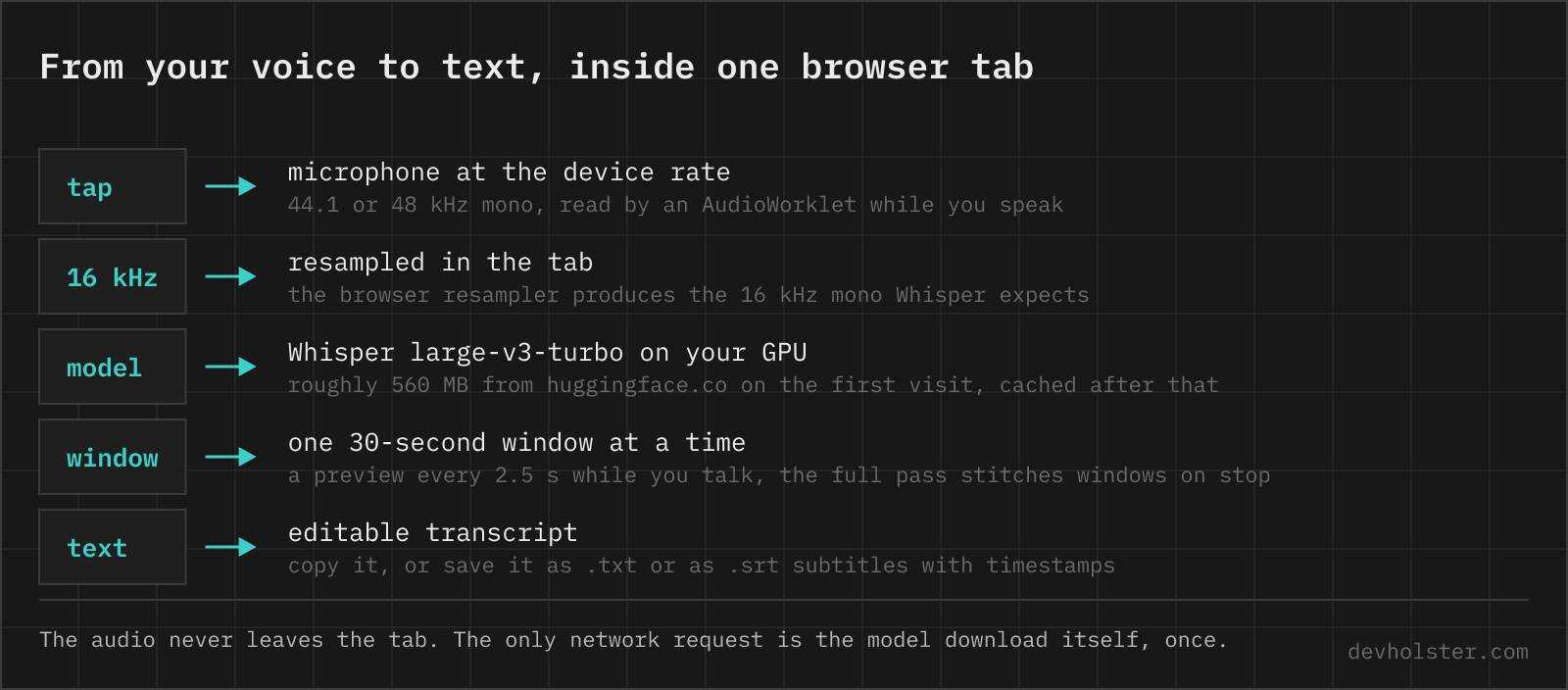
Instead, Whisper large-v3-turbo executes inside the tab with transformers.js, on your graphics card through WebGPU. The audio is tapped from the microphone, resampled to the 16 kHz mono Whisper expects, and handed to the model as numbers in memory. No recording is written anywhere, and no request carrying audio is made, which you can confirm in the network panel of your dev tools while dictating.
The one download is the model itself, once. It is stored in the browser's own cache storage, a reload or a visit next month does not fetch it again, and the page transcribes offline from then on.
The microphone permission is the only thing the page ever asks you for.
A free Wispr Flow alternative, with the trade named
Wispr Flow is the dictation product people compare everything against right now, and for good reason. It types into any app on your Mac or Windows machine, tidies your rambling as you go, and feels close to magic in daily use. Two things about it are easy to miss on the marketing pages.
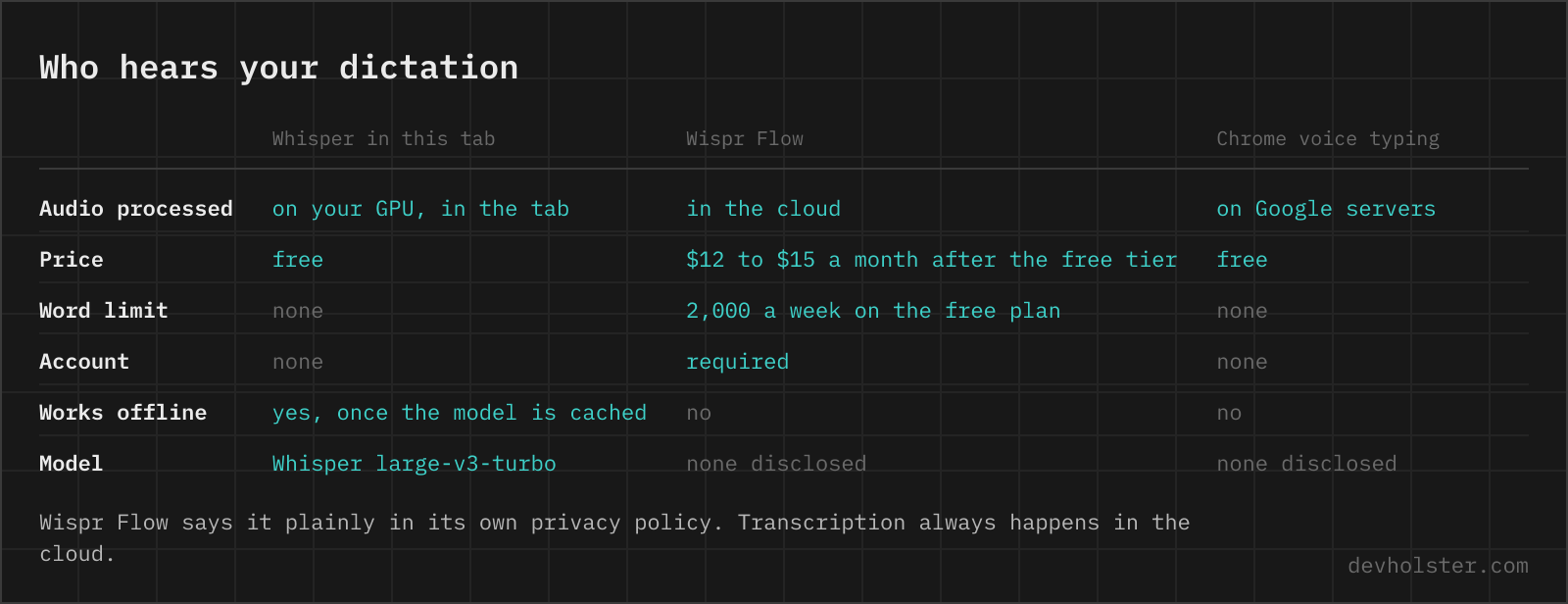
It is a cloud service. The privacy policy says so without hedging, "Transcription always happens in the cloud". Every sentence you dictate, in every app, crosses the wire to their servers and comes back as text.
And it is metered. The free plan stops at 2,000 words a week on desktop, which is 15 to 20 minutes of normal speech, and Pro costs $12 a month billed annually, $15 billed monthly. Those are the prices in September 2026.
A Whisper tab is the opposite trade. Nothing is metered because there is no server to pay for, nothing is uploaded because there is nothing to upload to, and the model is not a mystery, it is the same open large-v3-turbo half the transcription industry builds on. What you give up is the system-wide part. A browser tab cannot type into your editor or your mail client, so you dictate here and paste, or transcribe recordings. If you want system-wide dictation that stays on the device, that category exists too, superwhisper and MacWhisper run Whisper locally on macOS.
Running the model client-side has a price of its own, and we would rather name it than hide it. The first visit downloads half a gigabyte before the first word is transcribed, and a machine without WebGPU drops to a smaller, noticeably weaker model. We think that beats a word meter, but you pay it on the first load.
How accurate is Whisper large-v3-turbo
Turbo is OpenAI's pruned large-v3. The encoder, the half that listens, is unchanged. The decoder, the half that writes, went from 32 layers to 4, which is where the speed comes from, roughly eight times faster in the table of OpenAI's Whisper repository at 809 million parameters. OpenAI reports a minor quality drop against full large-v3, and on clean speech the two are hard to tell apart.
In practice the model is good at exactly the things classic dictation engines fail at. Accents, fast talkers, background noise and technical vocabulary all survive, because the training data was over five million hours of real-world audio rather than read-aloud corpora.
It has known weak spots, worth knowing before trusting a transcript blind:
- Names and jargon. A person or product name the model never saw gets replaced by the nearest common word, confidently.
- Numbers. Long digit sequences, IBANs and version numbers sometimes come back reformatted. Check them.
- Silence and music. On long stretches without speech, Whisper can invent text or loop a phrase. This is its best-documented failure mode.
One expectation to set. The very first transcription after the download is slower, because the GPU compiles its shaders on first use. From the second run on, an Apple-Silicon laptop transcribes at 1.5 to 2.5 times real time with this model.
99 languages, one setting
Whisper is a multilingual model and can detect the language by itself, by scoring every language token against the opening audio before it writes a word. This page does not run that step, on purpose. Detection is a full pass of the 32-layer encoder, and the encoder is where the time goes, so on a ten-second dictation it roughly doubles the wait. --language hands Whisper the language up front and the encoder runs once.
One recording, one language. Whisper transcribes the whole pass with the language token it was given, so a German sentence inside an English take comes out mangled rather than switched. Change the setting between takes instead.
From mp3, voice memo or video to subtitles
The same engine transcribes recordings. Drop an audio file onto the dark stage, or open one with the button next to the timer. Anything the browser can decode works, which covers mp3, wav, m4a, ogg, flac and webm, and video files, where the audio track is what gets read.
Whisper natively sees 30 seconds at a time, so longer material is cut into 30-second windows with a five-second overlap and stitched back together. You never see the seams, you see one transcript with segment timing behind it, and the .srt download turns that timing into subtitle cues ready for a player or a video editor.
There is no length cap. An hour-long recording is simply an hour of work for your GPU, which at two times real time means about half an hour of it.
Run Whisper in the browser, or install it
If you transcribe every day, install it. pip install -U openai-whisper gives you the reference CLI, and faster-whisper serves the same models with lower latency on NVIDIA hardware. A script that churns through a folder of interviews overnight belongs there, not in a tab.
The browser wins everywhere below that threshold. Nothing to install and nothing to update, which matters on a locked-down work laptop where pip is not an option. The same URL behaves the same on any machine with WebGPU. And the voice memo someone just sent you in a chat is transcribed before a Python environment would have finished resolving its dependencies.
Batch jobs and pipelines go to the CLI. Everything that starts with "can you quickly" stays in the tab.
What it will not do
No translation. Turbo was finetuned for transcription and returns the source language even when asked to translate, so the option does not exist here. No speaker labels either, Whisper does not know who spoke. And without WebGPU the page falls back to the small whisper-base model on the CPU, audibly less accurate.
Whisper questions, from pricing to hardware
Is Whisper free to use?
Yes. OpenAI released the code and every model size under the MIT license, so anyone can run or bundle them without paying.
Does Chrome voice typing send audio to Google?
Yes. Chrome's Web Speech API does the recognition on Google's servers, and Safari's version uses Apple's. Neither runs in the browser itself.
Is it safe to dictate confidential notes into an online speech to text tool?
Check where the recognition runs first, because for most dictation products the answer is a server. Wispr Flow's privacy policy states that transcription always happens in the cloud, Chrome's voice typing uses Google's servers, and most transcription websites upload the file. A page that bundles Whisper does the recognition inside the tab, and you can verify that yourself. Open the browser's network panel while dictating here. After the one-time model download, no request carries audio.
Is there a free Wispr Flow alternative without word limits?
Running Whisper yourself is the only route without a meter, since there is no per-word cost once the model is on your machine. Wispr Flow's free plan stops at 2,000 words a week on desktop, and Pro is $12 a month billed annually or $15 monthly. Local options are the whisper CLI, macOS apps like superwhisper and MacWhisper, or a browser tab like this one, which runs large-v3-turbo on your GPU with no account. The trade is scope. A tab cannot type into other apps the way Flow does.
How do I transcribe an audio file to text for free?
pip install -U openai-whisper, then whisper interview.mp3 --model turbo writes .txt, .srt and .vtt files next to the recording. That needs Python and a one-time model download. Without installing anything, drop the file onto the transcriber on this page. mp3, wav, m4a, ogg, flac and webm all decode, video files too.
Can Whisper translate audio into English?
Whisper large-v3 can, with --task translate, and only into English. The turbo model cannot. OpenAI finetuned it on transcription alone, and its own README warns that turbo returns the original language even when asked to translate. For any other target language, transcribe first and translate the text.
Does Whisper add punctuation automatically?
Yes. Punctuation, casing and sentence boundaries come out of the model itself, so there are no spoken comma commands to learn.
Which Whisper model should I use, turbo or large-v3?
Turbo, unless you need translation. It keeps large-v3's encoder, cuts the decoder from 32 layers to 4, and OpenAI measured only a minor accuracy drop for transcription at roughly eight times the speed. Reach for large-v3 when translating or on the hardest audio, and for tiny or base when only a CPU is available.
Why does Whisper repeat the same sentence over and over?
That is Whisper's best-known failure mode, a repetition loop. It usually starts on long silence, music or crosstalk, where the decoder has nothing solid to anchor on and starts feeding its own output back to itself. Cut the silent stretches, or put voice activity detection in front (faster-whisper bundles Silero VAD for exactly this). Chunked processing helps too, because a loop then dies at the next window boundary instead of poisoning the rest of the file.
How long does Whisper take to transcribe one hour of audio?
At the 1.5 to 2.5 times real time that large-v3-turbo reaches on an Apple-Silicon GPU through WebGPU, an hour of audio takes 25 to 40 minutes. A dedicated NVIDIA card running faster-whisper is quicker, a bare CPU far slower. The SPEED stat under the tool shows the multiple your machine reaches.
What hardware do I need to run Whisper locally?
For the CLI, OpenAI's README lists about 6 GB of VRAM for turbo and 10 GB for large-v3. The small models run on a CPU. In the browser the requirement is WebGPU, which Chrome, Edge and Safari 26 provide, and the quantised turbo is a 560 MB download. Without a usable GPU this page falls back to the 140 MB base model on the CPU.