A notice and a contract
A privacy policy exists because somebody outside your company demands it. Article 13 of the GDPR says the controller "shall, at the time when personal data are obtained, provide the data subject with" a list of information. California's CalOPPA tells the operator of a commercial site that collects personally identifiable information from Californians to "conspicuously post its privacy policy", and puts it in violation if the policy is still missing 30 days after a notice of noncompliance. Apple wants a link to one from every app, in the store listing and inside the app.
None of these texts asks the reader to agree to anything. The verbs are provide and post.
Terms of service work the other way. No law we have read makes a website publish a document with that name. Terms are an offer. They bind someone who accepted them and nobody else, and what they can contain is limited by the law of the person on the other side.
The difference shows when something goes wrong. A company that breaks its own terms has broken a contract with one customer. A company that breaks its own privacy policy has a problem with the state. Under section 22576 of the California Business and Professions Code an operator is in violation if it fails to comply with its posted policy, either knowingly and willfully or negligently and materially. The policy is a public statement of fact about what you do with data, and it is held against you as one.
So the two documents need different things from you. A privacy policy needs an inventory, and our guide to what counts as PII is a way to start one. The privacy policy generator turns the inventory into text. Terms need decisions about price, cancellation, liability and the rules of the house.
What goes into which
| Topic | Privacy policy | Terms of service |
|---|---|---|
| Which data is collected, and what for | yes | no |
| Legal basis and storage period | yes, for every purpose under the GDPR | no |
| Cookies and tracking | yes | no |
| Who receives the data | yes | no |
| Access, erasure, complaint to a regulator | yes | no |
| Price, renewal and cancellation | no | yes |
| 14-day withdrawal in the EU and the UK | no | yes, with the model form |
| What users may post, and how it is moderated | no | yes |
| Liability, governing law, courts | no | yes |
| Closing an account | what happens to the data | how the contract ends |
| Changes to the document | how they are announced | for which reasons, with what notice |
| Who operates the service, with contact details | yes | yes |
The rows that get mixed up most are the two about accounts and changes. "We may delete your account" is a contract term. "We delete your data 30 days after you close your account" is a statement about processing. A reader looking for one will not find it under the other, and a regulator reading your privacy policy does not read your terms to fill the gaps.
Payment is the other trap. That you charge monthly belongs in the terms. That the card number goes to a payment provider in another country belongs in the privacy policy.
The one checkbox for both
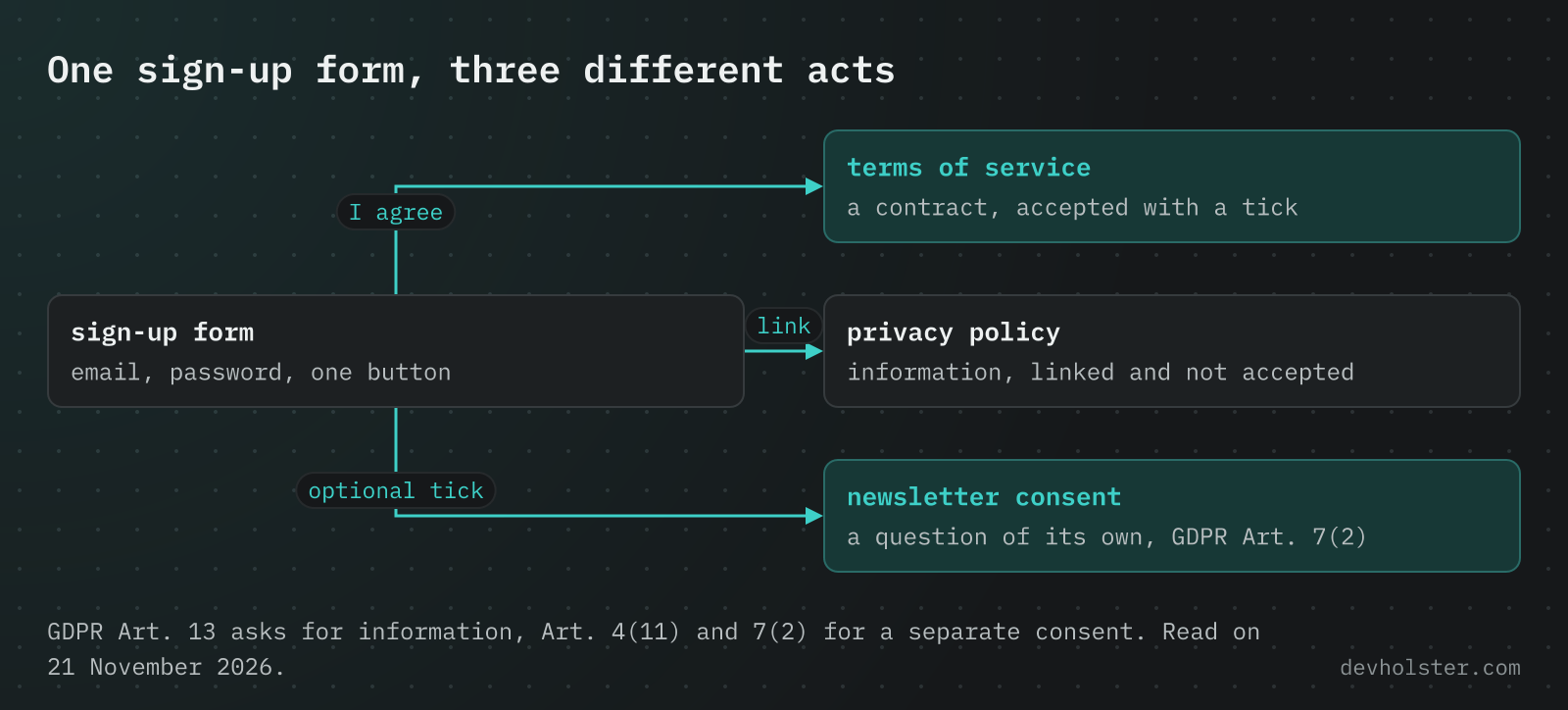
Most sign-up forms end with a single line: I agree to the Terms of Service and the Privacy Policy. It looks tidy, and it bundles three different acts.
[x] I agree to the Terms of Service
and the Privacy Policy. [x] I agree to the Terms of Service.
The Privacy Policy explains how
we handle your data.
[ ] Send me the monthly newsletter. Accepting the terms is the only one of the three that the tick really performs. The privacy policy needs no acceptance, so that half of the sentence adds nothing.
The third act is where it goes wrong in the EU. If any of your processing rests on consent, a newsletter for example, Article 4(11) of the GDPR wants that consent to be specific and given by a clear affirmative action. Article 7(2) adds that a request for consent inside a written declaration that also concerns other matters has to be "clearly distinguishable from the other matters". Any part of such a declaration that infringes the regulation is not binding.
Article 7(4) closes the remaining door. When a judge or a regulator assesses whether consent was freely given, "utmost account" is taken of whether the service was made conditional on consent to processing that the contract does not need.
The version on the right costs one more line on the form. We think that is cheap for a sign-up flow in which each act is what it claims to be.
Which one you need
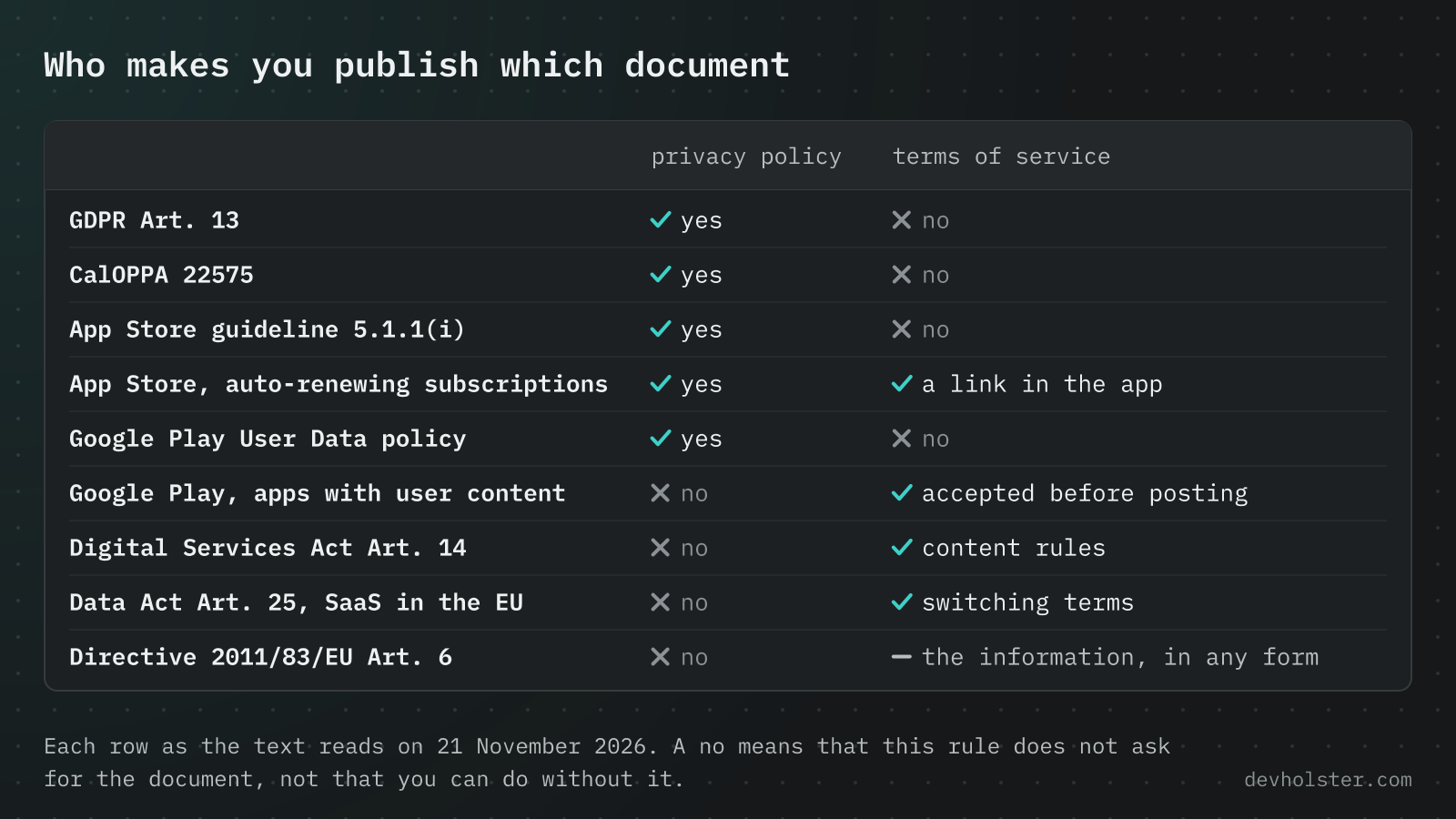
A privacy policy is demanded by laws and stores as soon as personal data is involved, and an IP address in a server log already counts. Terms are demanded by nobody in general and by several rules in particular, mostly once users post content, pay, or get the product from an app store.
A blog that people only read needs the first and can live without the second.
A SaaS with accounts and subscriptions needs both, and its terms carry more mandatory content than most founders expect. For consumers in the EU that is the right of withdrawal with its online function, for a hosted service the content rules of the Digital Services Act, and for SaaS the switching terms of the Data Act. The terms of service generator asks who your customers are before it writes any of it.
Changing them is not the same act either
You change a privacy policy when the facts change. A new analytics tool makes the old text false on the day it goes live, so the text has to follow. CalOPPA wants the policy to carry its effective date and to describe how material changes are announced. The GDPR adds a rule for the hard case. If data is going to be used for a purpose other than the one it was collected for, Article 13(3) wants people informed before that further processing starts.
Changing terms is changing a contract, and the other side has a say. In the EU and the UK, a term that lets a trader alter a consumer contract without a valid reason named in it is on the list of terms that may be unfair. A contract without a fixed end can be changed with reasonable notice if the consumer is free to leave.
That is why "we may update this document at any time" is harmless in one footer link and a problem in the other.
Two pages, and when one is enough
Keep two documents with two links, and make people accept only the terms. Put the privacy policy where it can be read before any data is entered, and treat every consent as a question of its own. That setup is correct in all three legal areas we have read, the EU, the UK and California, and it survives the day you add a newsletter or an app.
We do it that way on small projects too, and it has a price. There are two pages to keep current, and the privacy policy is the one that goes stale without anyone noticing.
The verdict is wrong for one kind of site, the one people only read. Without accounts, payments or comments there is no contract to write, and a set of terms copied in for completeness mostly adds clauses that bind nobody. Such a site needs one document, and it is the privacy policy.
Questions the footer links raise
Can the privacy policy and the terms of service be one document?
Technically yes, and it is a bad trade. California wants the privacy policy conspicuously posted, and Apple wants a link to the privacy policy in a metadata field of its own. Both are easier with a separate page. In the EU a request for consent inside a text that also covers other matters has to be clearly distinguishable from them (Article 7(2) GDPR), and a merged document works against that.
Do users have to agree to the privacy policy?
No. Article 13 of the GDPR makes the controller provide the information. It does not ask the reader to accept it.
Does a blog need terms of service?
No law requires terms for a site that people only read. A privacy policy is a different matter, because the server log of nearly every hosted site holds IP addresses. Terms become useful once the blog has comments, accounts or anything paid.
Is "by using this site you agree to our privacy policy" valid?
Not as consent under the GDPR. Consent there is an unambiguous indication of wishes, given by a statement or by a clear affirmative action (Article 4(11)), and continuing to browse is neither. The sentence is also unnecessary, because a privacy policy is information and needs no agreement.
What is the difference between a EULA and terms of service?
A EULA licenses a copy of software, and terms of service govern an ongoing service. For apps the line is blurry. Apple's developer agreement calls the agreement for an app a EULA and applies its standard EULA unless the developer supplies one. The same agreement asks for a link to the Terms of Use inside any app that sells auto-renewing subscriptions.
Does the refund policy go into the terms of service?
Yes, refunds are part of the contract. For consumers in the EU and the UK the 14-day right of withdrawal has to be explained before the order as well, with its model form, and the terms are the usual place for that.
Which document covers cookies?
The privacy policy. Cookies are about data, not about the contract.