Fourteen fields, five definitions
| Field | NIST SP 800-122 | CalOPPA § 22577(a) | CCPA § 1798.140(v) | GDPR Art. 4(1) | California breach notice § 1798.82(h) |
|---|---|---|---|---|---|
| First and last name | named | named | named | named | only next to a second element such as an SSN or a card number with its code |
| Email address | named | named | named | covered | only with a password or security answer |
| Phone number | named | named | named | covered | no |
| Social security or passport number | named | SSN named | named | covered as identification number | with the name |
| IP address | named, if it consistently links to one person or a small group | only with a listed identifier | named | named in recital 30 | no |
| Cookie or session ID | when linked | only with a listed identifier | named | named in recital 30 | no |
| Device ID, MAC address, advertising ID | MAC address named, same condition | only with a listed identifier | named | covered as online identifier | no |
| Internal user ID or UUID | when linked | only with a listed identifier | named as customer number or pseudonym | covered as identification number | no |
| SHA-256 of an email address | when linked | only with a listed identifier | covered as unique pseudonym | covered, pseudonymised | no |
| GPS position | when linked | only with a listed identifier | named | named as location data | no |
| Purchase history | when linked | only with a listed identifier | named | covered | no |
| Date of birth | named | only with a listed identifier | covered | covered | no |
| Sign-ups per month, as a count | no | no | no, aggregate | no, anonymous | no |
| Generated test record | no | no | no | no | no |
Two columns explain most of the confusion. CalOPPA dates from 2003 and its list stops at contact details. From the fifth row down a field gets in only through its last item, information kept "in combination with" one of the listed identifiers. The breach column is narrower still, and incident runbooks in the US are written around statutes like it.
The GDPR column says no in the last two rows and nowhere else.
PII is an American word
The definition most people repeat comes from NIST SP 800-122, a guide for federal agencies published in April 2010. It has two halves. The first is information that can "distinguish or trace an individual's identity", such as a name, a social security number or biometric records. The second is anything "linked or linkable" to that individual, with medical, educational, financial and employment information as examples.
European law never uses the term. The GDPR says personal data and defines it in Article 4(1) as "any information relating to an identified or identifiable natural person". There is nothing to tick a field against. The test is whether a person can be picked out, directly or indirectly, and the article mentions names, identification numbers, location data and online identifiers only as examples.
California has both. CalOPPA, the law behind most privacy policy links in a footer, says personally identifiable information and gives a list of seven items. The CCPA says personal information, extends it to households, and runs to twelve categories, down to the inferences a business draws about a consumer.
The damage shows up in documents. A schema review that closes with "no PII in this table" means no names and no email addresses to the engineer who wrote it. A customer in Frankfurt reads the same sentence as a statement about personal data, and the table has a user_id and an ip column.
Is an IP address PII?
Under the CCPA, yes. "Internet Protocol address" stands in the first category of the definition, between online identifier and email address.
Under the GDPR the answer has been yes for practical purposes since 19 October 2016. In Breyer, Case C-582/14, the Court of Justice of the EU looked at a website operator that stored the dynamic IP addresses of its visitors. The operator could not name anyone from an address alone. The court held that the address is personal data for the operator all the same, where it has legal means to have the visitor identified with the records of the internet provider. That ruling was about the directive before the GDPR. Recital 30 of the GDPR now names IP addresses and cookie identifiers outright.
NIST is more careful. Its example list has IP and MAC addresses in it, on the condition that the address "consistently links to a particular person or small, well-defined group of people". An office gateway shared by 400 people fails that test. A home connection that keeps its address for months passes it.
CalOPPA does not mention IP addresses, and neither does California's breach notification law.
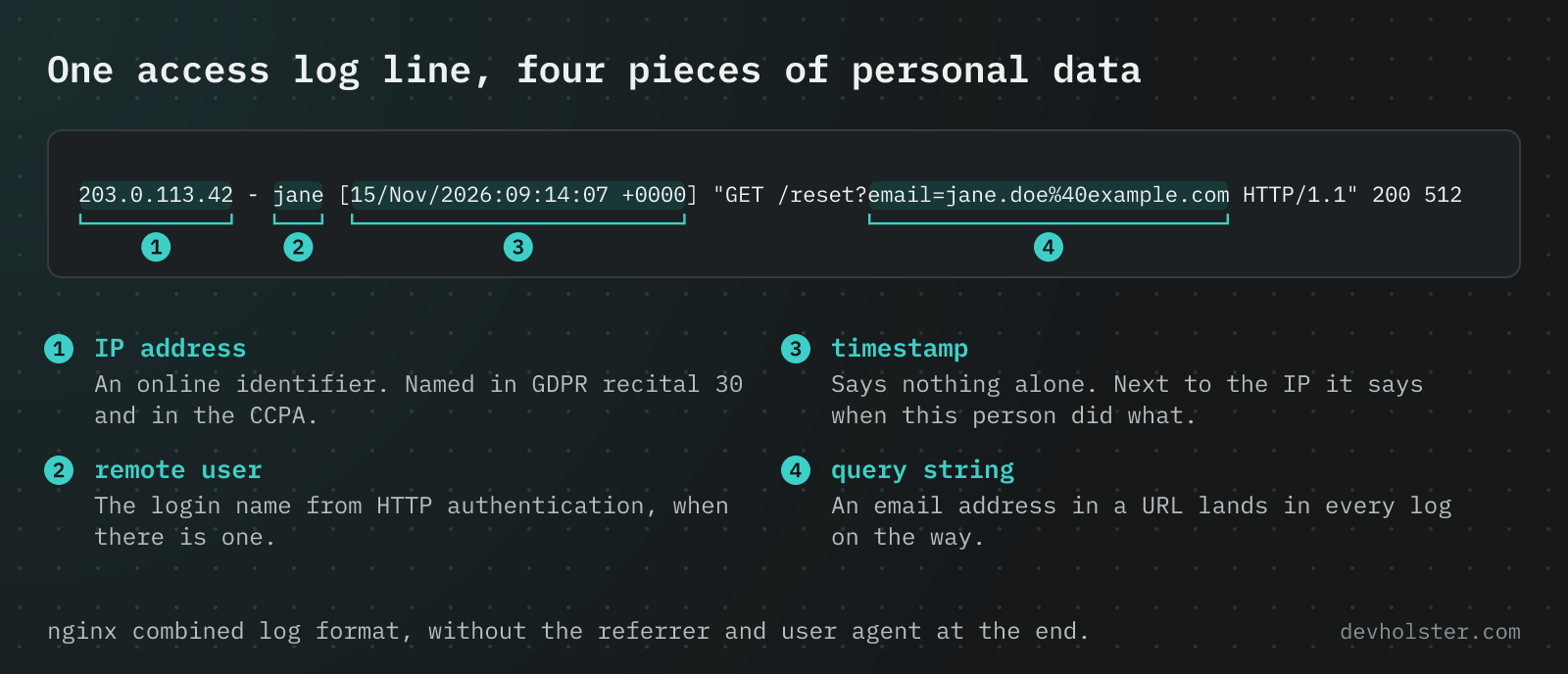
For a developer the consequence sits in the first field of the access log. The combined log format of nginx starts every line with $remote_addr, so a site with no form, no account and no analytics still processes personal data, in a file most teams never open. That is why server logs are the first purpose our privacy policy generator asks about. Tick it for a blog with nothing but hosting, and the policy gets a paragraph on IP addresses with a legal basis and a storage period.
A hashed email is still an email
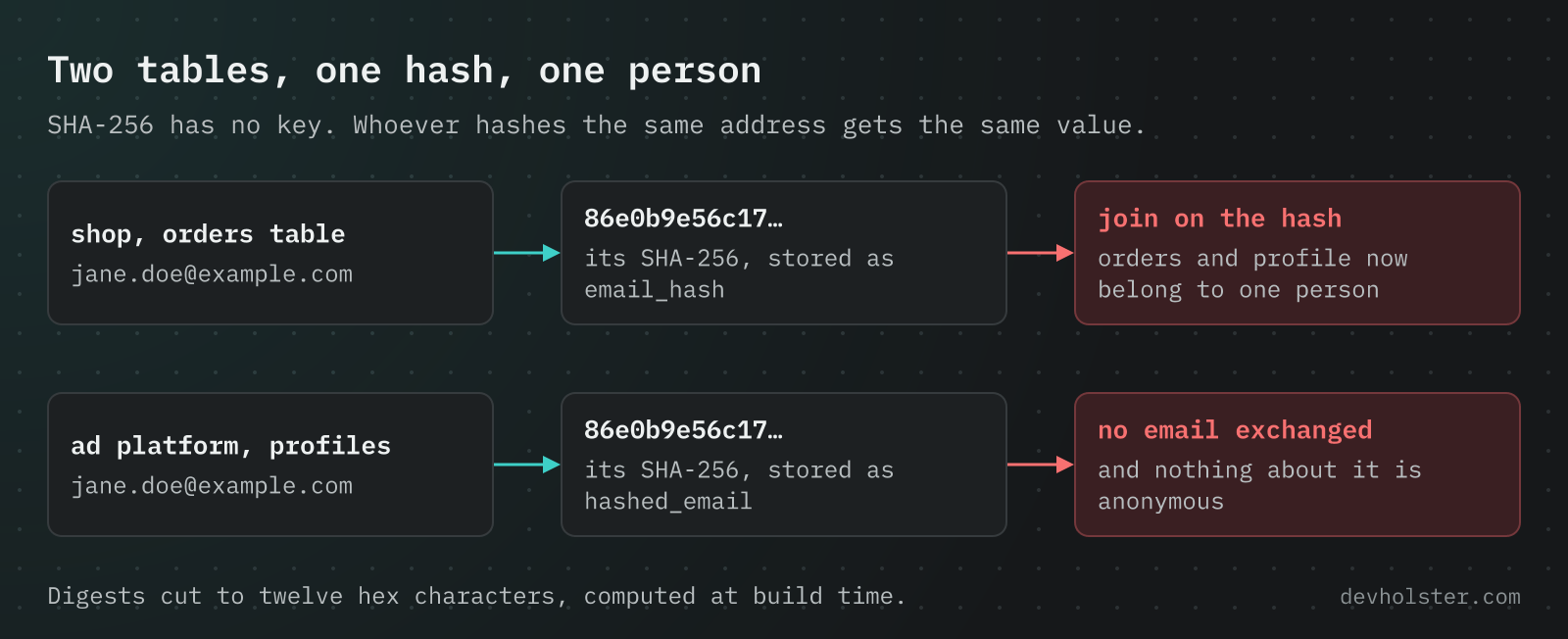
The standard move is to hash the column and call the result anonymous.
$ printf 'jane.doe@example.com' | shasum -a 256
86e0b9e56c17cc4d12387e1949b85053fbe73bc3ce5a1188713a9d300cc6133d  -
Run that on any machine and the same 64 characters come out, which is the whole problem. Two companies that hash the same address hold the same value and can join their tables on it. Matching customer lists between an advertiser and a platform works exactly this way. The SHA-256 generator shows it without a terminal.
The FTC made the point in the title of a post from July 2024, "No, hashing still doesn't make your data anonymous". Its staff wrote that data is only anonymous when it can never be associated back to a person. The cases it cites start in 2015 with Nomi, over in-store tracking by hashed MAC address, and include BetterHelp, over hashed email addresses shared with Facebook.
Small input spaces also fall to plain counting.
$ openssl speed -seconds 3 -bytes 16 sha256
type             16 bytes
sha256          133454.02k
The figure is in thousands of bytes per second, so one laptop core does about 8.3 million hashes of a 16-byte input per second. There are 4,294,967,296 IPv4 addresses. Hashing every one of them takes that core under nine minutes, and after that each hashed IP in a table is a lookup away from the original.
A keyed hash stops the lookup. It does not change what the value is. The output is a stable pseudonym, recital 26 of the GDPR says pseudonymised data that can be attributed to a person with additional information is still information on an identifiable person, and the party holding the key holds the additional information.
When data stops being personal
Data leaves all five definitions in two ways. Either it never described a person, or the link to the person is gone for good.
Aggregates are the easy case. "412 sign-ups in May" says nothing about any one of them. Recital 26 calls that anonymous information and the CCPA excludes aggregate consumer information in so many words. A count of one is not an aggregate, though. "One sign-up from Liechtenstein on Tuesday" is a person.
Generated data is the other easy case. A record from the test data generator has no source row to lead back to.
Everything in between depends on who holds the key. On 4 September 2025 the Court of Justice ruled in EDPS v SRB, Case C-413/23 P, that pseudonymised data is not personal data in all cases and for every person. A recipient with no reasonable means of re-identifying anyone may hold data that is not personal for them. The same judgment says the duty to tell people who receives their data is judged at the time of collection and from the point of view of whoever collected it. The case concerned the regulation for EU institutions, whose definition the court calls essentially identical to the GDPR's. For a privacy policy the upshot is that the recipient gets listed, whether or not it can read the names.
One field, six duties
Which definition counts depends on what you are about to do with the answer.
| What you are doing | Text that decides | Is an IP address in? |
|---|---|---|
| Writing a privacy policy for visitors in the EU | GDPR Art. 13, definition in Art. 4(1) | yes |
| Writing one for visitors in California | CalOPPA § 22577(a) | only next to a listed identifier |
| Answering CCPA requests as a covered business | Cal. Civ. Code § 1798.140(v) | yes |
| Deciding whether a leak needs a notice in California | Cal. Civ. Code § 1798.82(h) | no |
| Running a service directed at children under 13 | COPPA rule, 16 CFR 312.2 | yes, as a persistent identifier |
| De-identifying health records | HIPAA, 45 CFR 164.514(b)(2) | yes, one of 18 identifiers to remove |
The fourth row is why PII sounds narrow to engineers in the US. California's breach section asks for a name plus something like a social security number, or a login plus its password. A leaked table of IP addresses and page views triggers no notice under it. The same leak is a personal data breach as Article 4(12) of the GDPR defines one.
The cheap rule is to treat every identifier that outlives a session as personal data, wherever the user sits. It costs a longer privacy policy and a retention setting on logs nobody had thought about. In return the argument per field and per jurisdiction never has to happen.
Where it hides in a codebase
The users table is the part everyone remembers. These are the places a review tends to skip.
- Access and error logs, with the IP address, the user agent and whatever was in the URL.
- Query strings. An
?email=parameter ends up in the log, in the Referer header of the next request and in the analytics tool. - Error tracker payloads, where request bodies travel with the stack trace.
- HAR files attached to tickets. A HAR export holds the session and every API response the page received.
- JWT payloads. Anyone holding the token can read them in a JWT decoder, and so can every system that logs the Authorization header.
- Uploaded photos, which carry GPS coordinates in their EXIF data unless someone strips them.
- Staging databases restored from a production dump.
- Queries pasted into an AI assistant with a customer's email address in the WHERE clause. The SQL anonymizer masks string literals before the query leaves the tab.
Write that list down before anything else.
Each line on it is an answer in a privacy policy. Article 13 of the GDPR wants the purpose, the legal basis and the storage period for every one, and the app stores want the data types. The privacy policy generator asks those questions per purpose and shows no text until they are answered, so the inventory is most of the work.
PII questions from schema reviews
What does PII stand for?
Personally identifiable information. The term comes from US government guidance, and European law says personal data instead.
What is the difference between PII and personal data?
PII is a US term with several definitions, most of them lists. NIST SP 800-122 covers information that can distinguish or trace a person plus anything linked or linkable to them, and CalOPPA lists seven items from name to social security number. Personal data is the GDPR term, defined in Article 4(1) as any information relating to an identified or identifiable natural person. It has no list, so cookie IDs, device IDs and internal user IDs fall under it as soon as they can be tied to one person. Nearly everything that counts as PII is personal data. The reverse does not hold.
Is an email address PII?
Yes. NIST SP 800-122, CalOPPA and the CCPA each list it by name, and under the GDPR it is personal data whenever it belongs to a person.
Is an IP address personal data under the GDPR?
For a website operator, yes. Recital 30 names internet protocol addresses as online identifiers, and in Breyer (C-582/14, 19 October 2016) the Court of Justice held that even a dynamic IP address is personal data for a site operator that has legal means to have the visitor identified through the internet provider. In practice that covers every access log.
Is a MAC address PII?
It can be. NIST SP 800-122 lists MAC addresses next to IP addresses, on the condition that the address consistently links to a particular person or a small group. The CCPA counts device identifiers as unique personal identifiers, and the FTC brought a case in 2015 over in-store tracking by hashed MAC address.
Is date of birth PII?
Yes. The NIST definition names date and place of birth among the information that can distinguish or trace an identity.
Is a zip code PII?
Under HIPAA it is an identifier. The de-identification rule in 45 CFR 164.514(b)(2) removes every geographic unit smaller than a state, zip codes included, and keeps only the first three digits where that area has more than 20,000 residents. Outside health data a zip code alone rarely identifies anyone, but next to a birth date it narrows a table down fast.
What is sensitive PII?
There is no single list. NIST SP 800-122 does not use a sensitive category. It asks for a confidentiality impact level of low, moderate or high per data set. The GDPR has a fixed list in Article 9: racial or ethnic origin, political opinions, religious or philosophical beliefs, trade union membership, genetic data, biometric data used to identify a person, health data, and data on sex life or sexual orientation. Processing those is prohibited unless one of the exceptions in Article 9(2) applies.
Is pseudonymized data still personal data?
For whoever holds the key or the lookup table, yes. Recital 26 of the GDPR says pseudonymised data that can be attributed to a person with additional information is information on an identifiable person. For a recipient who has no reasonable way to re-identify, the Court of Justice ruled on 4 September 2025 (C-413/23 P) that the same data is not personal data in every case.
Is encrypted data still PII?
Yes. The CCPA says personal information can exist in compressed or encrypted files. Encryption changes the breach rules instead. California requires notice for encrypted data only if the key was taken too.
Is PHI the same as PII?
No. PHI is health information under HIPAA, tied to a health provider, plan or clearinghouse. Its safe harbor names 18 identifiers to remove, among them IP addresses, URLs and device serial numbers.
How do I find PII in a database?
Start with the column names, then sample the free-text columns. In PostgreSQL, SELECT table_name, column_name FROM information_schema.columns WHERE column_name ~* 'mail|phone|name|birth|address|ip|token' lists the obvious candidates in a second. The misses are columns such as notes, payload or metadata, where users and support staff type whatever they like, and JSON columns that carry a whole request. Run a regular expression for email addresses over a sample of those, and check the log tables the same way, because a URL column holds every query string the app ever received.